
If your landlord just messaged you about a rent increase — or handed you an eviction notice — you need to know your rights under Dubai rental laws before you respond. This guide covers every rule that protects you as a tenant in 2026, including how much rent can legally go up, how eviction works, and how to fight back if your landlord crosses the line.
Quick Answer: Dubai rental law — key facts at a glance (2026)
- Governing law: Law No. 26 of 2007, amended by Law No. 33 of 2008
- Rent increases: Capped by the Real Estate Regulatory Agency (RERA) index — max 20%, once per year, with 90 days’ written notice required
- Ejari: Mandatory for all leases — without it, no DEWA connection, no residence visa, no protection at the Rental Disputes Centre
- Eviction: Requires 12 months’ notarized notice for personal use, sale, or renovation — mid-lease eviction is almost never legal
- Security deposit: Maximum 5% of annual rent (unfurnished), 10% (furnished)
- Disputes: File at the Rental Disputes Centre (RDC) — fee is 3.5% of annual rent (min AED 500, max AED 20,000)
The legal framework: which laws govern Dubai rental laws?
Dubai rentals are governed by a layered set of laws — knowing which one applies to your situation is the first step to protecting yourself.
Law No. 26 of 2007 — the foundation
Law No. 26 of 2007 is the cornerstone of all Dubai tenancy relationships. It defines the rights and obligations of both landlord and tenant, sets the framework for contract registration, and establishes the Rental Disputes Centre as the legal body for resolving disagreements.
Law No. 33 of 2008 — the amendment
Law No. 33 of 2008 amended the original law and added critical tenant protections, including the requirement that landlords provide proper written notice for rent increases and the strengthening of security deposit rules. Most of the practical rights tenants rely on today come from this amendment.
Decree No. 43 of 2013 — the rent cap rule
Decree No. 43 of 2013 is the law that controls exactly how much your rent can go up. It created the tiered RERA rental index system — the percentage caps that link any allowable increase to how far your current rent sits below market rate. This is the decree you need when your landlord quotes a number that feels too high.
Who enforces the rules? DLD, RERA, and RDC explained
Three bodies matter here. The Dubai Land Department (DLD) oversees property registration and policy. The Real Estate Regulatory Agency (RERA) — a division of DLD — manages the rental index and mediates minor disputes. The Rental Disputes Centre (RDC) is the court that handles formal cases. If your landlord won’t back down, RDC is where you go.
If you’re also setting up your residency documents, see our guide on UAE visa status check to confirm your visa is active before filing any official dispute.
Ejari registration — why it matters more than you think
Ejari is not just bureaucratic paperwork — it is the legal existence of your tenancy contract in Dubai’s system.
What is Ejari and who registers it?
Ejari (Arabic for “my rent”) is the online registration system operated by the DLD. Every tenancy contract in Dubai must be registered here. In practice, most landlords or their agents handle registration — but it is ultimately the landlord’s legal obligation. If your landlord refuses to register, you can report this to RERA.
What you cannot do without a registered Ejari
Without a valid Ejari certificate, you cannot connect DEWA (Dubai Electricity and Water Authority) utilities in your name, you cannot apply for or renew a UAE residence visa linked to that address, and you have no standing to file a case at the RDC. An unregistered lease is a lease with no protection.
How to register Ejari (step by step, 2026)
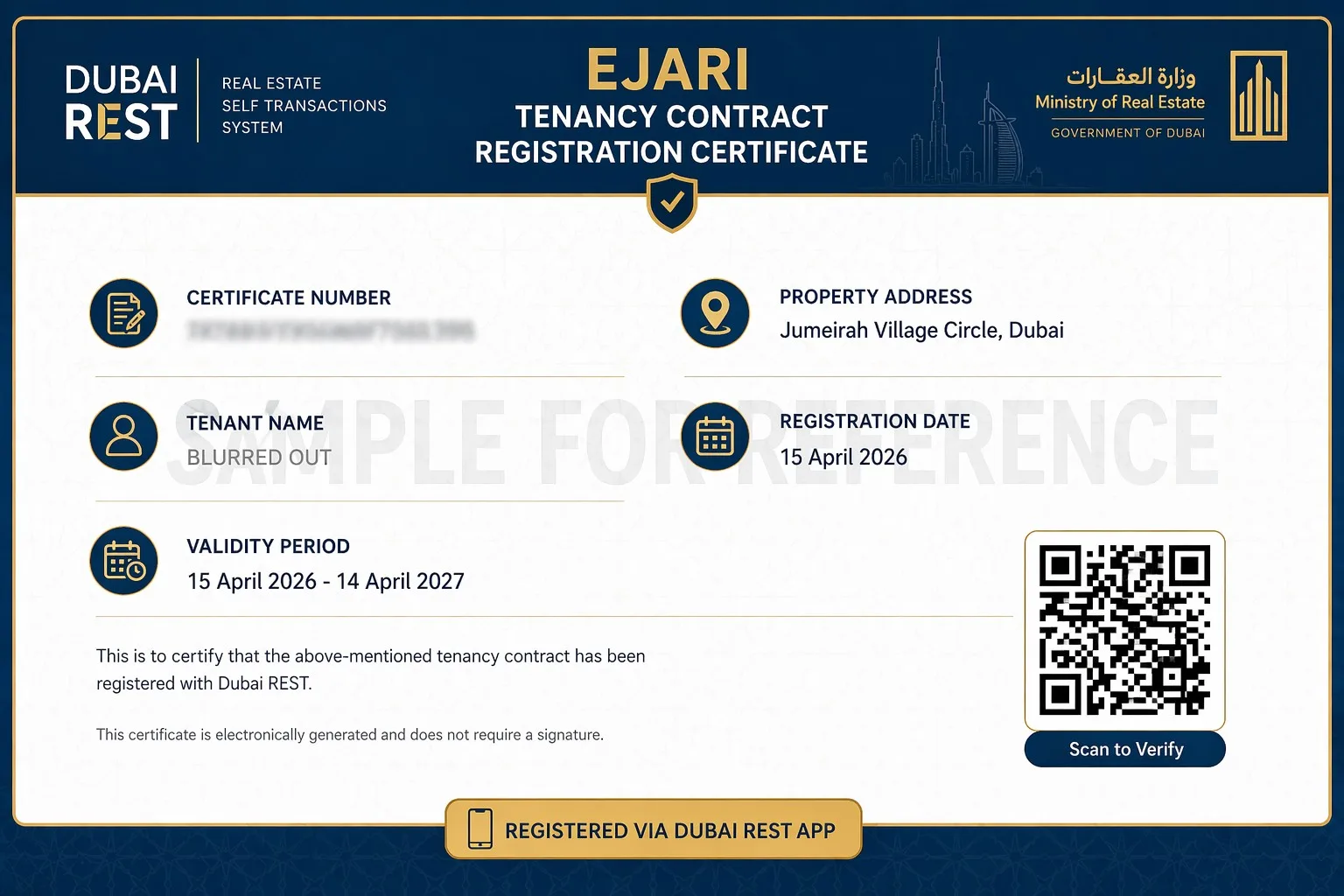
Registration takes about 15 minutes via the Dubai REST app or the Ejari portal. You need your signed tenancy contract, your Emirates ID, your landlord’s title deed, and your previous Ejari certificate if this is a renewal. The fee is AED 220 for individuals registering through the app.
New 2026 rule: all co-occupants must be listed
From 2026, Ejari registration requires all adults co-occupying the unit to be listed on the tenancy registration — not just the contract holder. This affects couples, families, and flatshares. If you have co-occupants not yet listed on your Ejari, update it at your next renewal.
RERA rent increase rules — how much can your landlord raise rent in 2026?
Your landlord cannot simply decide to raise your rent — the Real Estate Regulatory Agency (RERA) sets hard percentage caps tied to current market rates.
The tiered RERA rent increase table (Decree 43)
The maximum allowable increase depends on how far your current rent sits below the RERA Smart Rental Index average for your area and property type.
| Current rent vs RERA market average | Maximum allowable increase |
|---|---|
| At or above market average | 0% — no increase permitted |
| 1–10% below market average | 0% — no increase permitted |
| 11–20% below market average | Up to 5% |
| 21–30% below market average | Up to 10% |
| 31–40% below market average | Up to 15% |
| More than 40% below market average | Up to 20% |
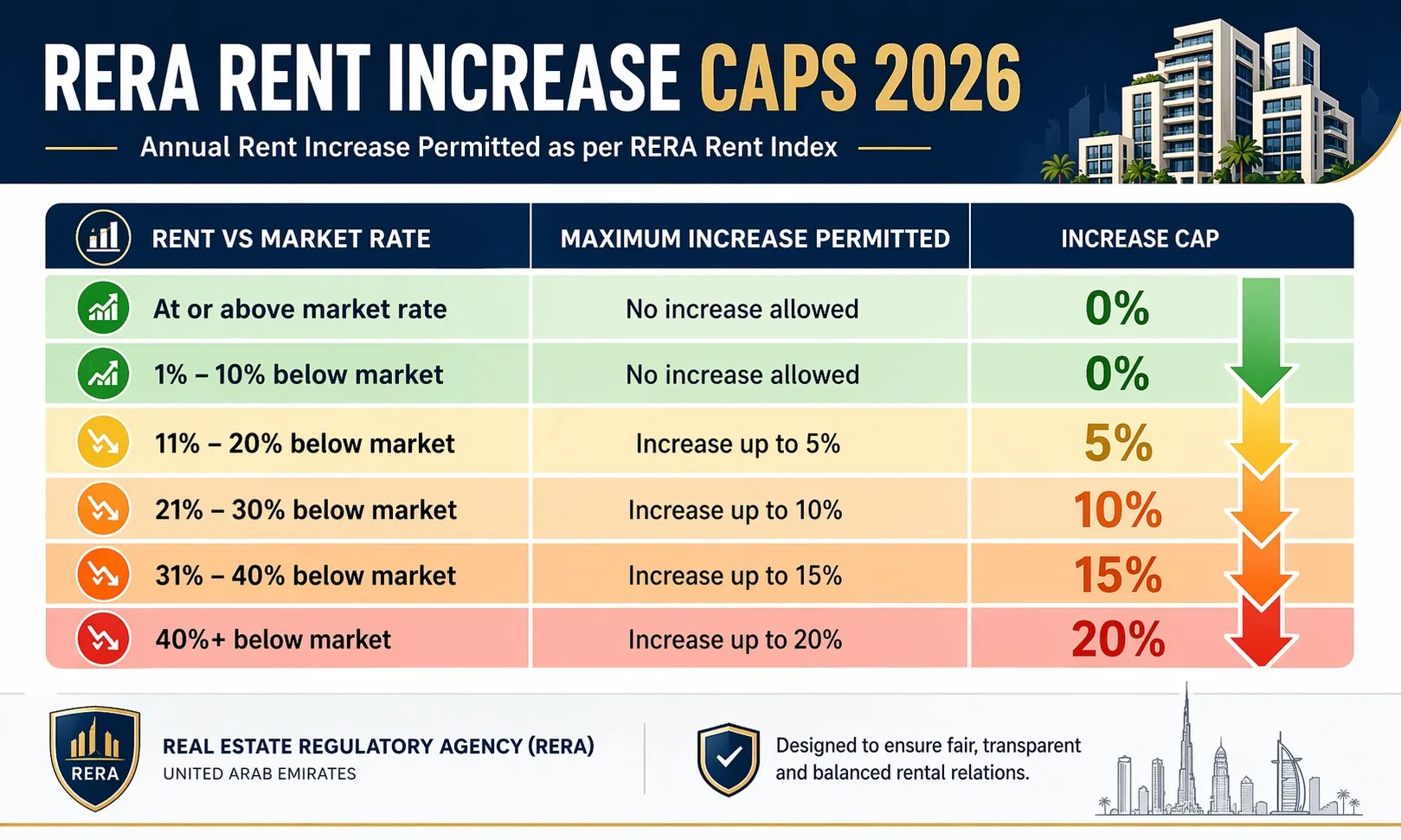
Worked AED example: Your current rent is AED 70,000/year. The RERA index shows the market average for your building and apartment type is AED 90,000. Your rent is approximately 22% below market — which puts you in the 21–30% bracket. Your landlord can legally raise your rent by up to 10%, meaning a maximum new rent of AED 77,000. Any demand above AED 77,000 can be challenged at the RDC.
The 90-day notice rule — and what happens if your landlord misses it
A rent increase is only legally valid if your landlord gives you written notice at least 90 days before your renewal date. If they miss this window, you are legally entitled to refuse the increase and renew at your existing rent. This is one of the most commonly overlooked tenant rights in Dubai — most people simply accept the increase because they don’t know the deadline matters.
🗣 Real Talk In practice, most Dubai landlords send rent increase notices via WhatsApp. That is not legally sufficient. The notice must be formal, in writing, and served at least 90 days before your contract renewal date. If your landlord sends a WhatsApp message in November for a January renewal, you can legally decline the increase. Keep screenshots of every communication — they count as evidence at the RDC.
How to use the RERA Rental Index calculator
Go to the Dubai REST app or the RERA website and use the Smart Rental Index tool. Enter your area, building name, and apartment type. The tool returns the current market average — compare that to your rent to determine which bracket you fall into before responding to any increase notice.
Example: worked AED calculation for a real Dubai apartment
A tenant in a 2-bedroom apartment in Jumeirah Village Circle pays AED 65,000/year. The RERA index for that area and apartment type shows AED 85,000. Their rent is 23.5% below market — so the maximum legal increase is 10%, bringing their rent to AED 71,500. Their landlord demanded AED 80,000. That demand is AED 8,500 above the legal maximum and is fully contestable.
For broader financial context, read our upcoming cost of living in Dubai 2026 guide for a full monthly budget breakdown.
Eviction rules — when can a landlord legally ask you to leave?
A Dubai landlord cannot evict you on a whim — the law sets out exactly four circumstances where eviction is permitted, and the process is strict.
Mid-lease eviction (breach of contract only)
During an active lease term, a landlord can only evict you for a material breach of the tenancy contract — most commonly non-payment of rent for 30 days after a formal notice. Normal day-to-day disagreements, subletting disputes, or a landlord simply wanting the unit back do not qualify as grounds for mid-lease eviction.
End-of-lease eviction — the 4 legal grounds
At lease renewal, a landlord can choose not to renew for four specific reasons only: they intend to sell the property, they want to move into it themselves or for a first-degree relative, they plan to demolish or carry out major renovation requiring the unit to be vacant, or the property requires government-mandated upgrades. None of these can be used casually — each requires formal documentation.
The 12-month notarized notice requirement
For any eviction on end-of-lease grounds — personal use, sale, or renovation — the landlord must serve a notarized eviction notice via a notary public or registered mail. This notice must be given at least 12 months before the required vacation date. A WhatsApp message, email, or verbal request does not count as valid notice regardless of how early it is sent.
What if your landlord evicts you then re-lets the property?
This is the clause most tenants have never heard of. If a landlord evicts you on grounds of personal use or renovation, and then re-lets the property to a new tenant within two years of your eviction date, you have the legal right to claim compensation of up to one year’s rent from that landlord. Document your eviction notice and check on the property — this protection is real and enforceable at the RDC.
Security deposit rules
Your landlord cannot use your security deposit as a general slush fund — the law is specific about what they can and cannot deduct.
Deposit caps: 5% unfurnished, 10% furnished
The maximum security deposit a landlord can legally charge is 5% of the annual rent for an unfurnished property and 10% for a furnished one. If you were charged more than this at signing, you can claim the excess back.
What landlords can and cannot deduct
Landlords can deduct the cost of repairing damage caused by the tenant — broken fixtures, stained walls beyond normal use, damaged appliances. They cannot deduct for fair wear and tear: minor scuffs on walls, small marks on flooring from furniture, or any deterioration that results from ordinary use of a property over time.
Wear and tear vs damage — the distinction that matters
A carpet that is slightly worn after two years of living is wear and tear. A carpet with a burn mark or a large stain is damage. A wall with faded paint is wear and tear. A wall with a hole punched in it is damage. When in doubt, document the property’s condition with photos at move-in and move-out — this evidence is decisive at the RDC.
How to get your deposit back
Your landlord must return the deposit within a reasonable time after you vacate — typically at handover or within a few days. If they refuse or delay, send a formal written request. If no resolution within 30 days, file at the RDC. Bring your move-in and move-out inspection reports.
Maintenance — who is responsible for what?
The landlord is responsible for keeping the property habitable — the tenant is responsible for keeping it clean and undamaged.
Landlord’s responsibilities (structural, AC, plumbing)
Under Dubai rental law, the landlord must maintain all structural elements, the HVAC/AC system, plumbing, electrical systems, and any built-in appliances. If your AC breaks in August, that is a landlord repair — not a tenant problem.
Tenant’s responsibilities (minor repairs)
Tenants are generally responsible for minor maintenance: replacing light bulbs, unclogging drains caused by misuse, minor touch-up repairs. The dividing line is whether the issue arose from normal use or from a structural/system failure.
What to do if your landlord ignores a maintenance request
Send a written request (WhatsApp or email creates a timestamp). If no response within a reasonable time, escalate to a formal written notice. If still ignored, you can file a complaint with RERA before escalating to the RDC. In urgent cases involving habitability — broken AC in summer, no running water — RERA can move quickly.
New in 2026 — monthly rent payments are now an option
Starting 2026, Dubai tenants can legally request to pay rent on a monthly basis rather than the traditional one, two, or four-cheque system. This is a significant change for expats managing cash flow. Landlords are not legally required to accept monthly payments, but they cannot prohibit it in the tenancy contract. Negotiate this at signing or renewal — more landlords are now open to it than in previous years.
If you’re weighing whether to stay or start your own venture, our guide on how to start a business in UAE covers commercial tenancy requirements separately.
How to file a rental dispute with the RDC
If your landlord is breaking the law, the Rental Disputes Centre (RDC) is where you get resolution — and it is more accessible than most people think.
Step 1 — try RERA mediation first
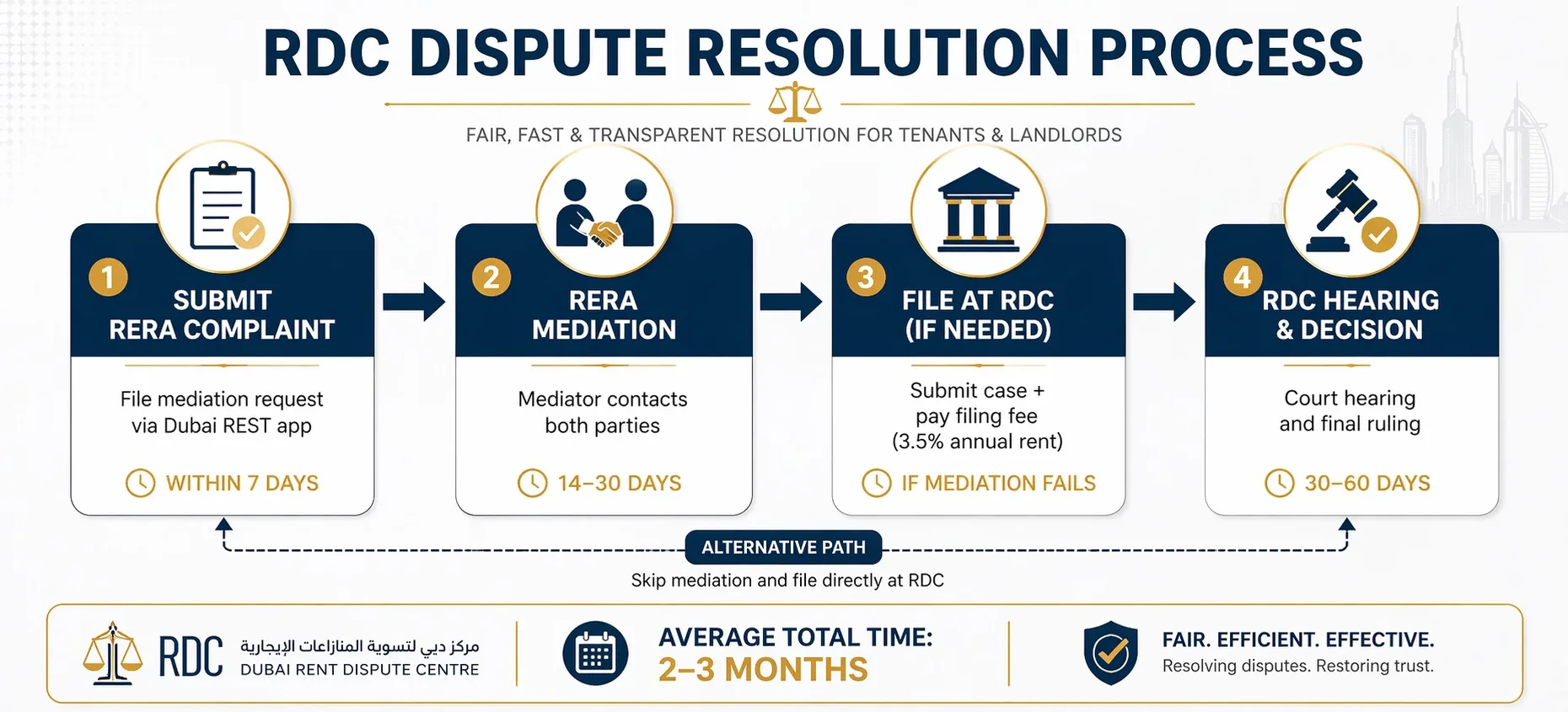
Before filing formally, you must attempt mediation through RERA. Submit a complaint via the Dubai REST app or in person at RERA’s offices. A mediator will contact both parties. Many disputes — particularly around deposits and minor rent disagreements — are resolved here without going to court.
Step 2 — file with RDC if mediation fails
If mediation fails or your landlord does not respond, you escalate to the Rental Dispute Center (RDC). File your case online via the RDC portal or in person at the RDC building in Deira. Submit your tenancy contract, Ejari certificate, communication records, and any evidence (photos, inspection reports, bank transfer receipts).
Filing fees (3.5% of annual rent, min AED 500, max AED 20,000)
The RDC filing fee is 3.5% of your annual rent. For a tenant paying AED 70,000/year, that is AED 2,450. The minimum fee is AED 500 regardless of rent amount, and the maximum is AED 20,000. If you win, the court can order your landlord to reimburse these fees.
How long does an RDC case take?
Straightforward cases — deposit disputes, illegal rent increases — typically resolve within 30 to 60 days. Complex eviction disputes or multi-party cases can take three to six months. The RDC has a reputation for being relatively efficient by regional standards.
Do you need a lawyer?
For most standard tenant cases — deposit disputes, illegal rent increases, basic eviction challenges — you do not need a lawyer. The RDC system is designed to be accessible to individuals. For complex cases involving large sums or developer disputes, a lawyer who specialises in UAE property law is worth the cost.
Tenant rights checklist — 10 things your landlord cannot do
- Raise rent without giving 90 days’ written notice before renewal
- Raise rent beyond the RERA index caps under Decree No. 43 of 2013
- Evict you mid-lease for any reason other than a material breach of contract
- Evict you at lease end without serving a 12-month notarized notice
- Re-let the property within two years of evicting you for personal use
- Charge a security deposit above 5% (unfurnished) or 10% (furnished) of annual rent
- Deduct normal wear and tear from your security deposit
- Refuse to register the tenancy with Ejari
- Disconnect or threaten to disconnect your utilities as a form of pressure
- Enter the property without giving reasonable prior notice (typically 24 hours)
FAQs
Can my landlord increase rent without giving 90 days’ notice?
No. Under Dubai rental law, a rent increase is only legally valid if the landlord provides written notice at least 90 days before the tenancy renewal date. If the notice arrives fewer than 90 days before your renewal, you are legally entitled to refuse the increase and renew at your current rent. Document the date you received any notice.
What happens if my landlord increases rent beyond the RERA limit?
You can refuse to pay the excess amount and file a case with the Rental Disputes Centre (RDC). Bring a printout from the RERA Smart Rental Index showing the market rate, your tenancy contract, and the landlord’s increase notice. The RDC can order the landlord to reduce the rent to the legal maximum.
Can a landlord evict me to sell the property?
Yes, but only if they follow the correct process. The landlord must provide a notarized eviction notice at least 12 months in advance and prove a genuine intention to sell. They cannot use “sale” as a pretext to evict you and then re-let — if they do, you are entitled to up to one year’s rent in compensation.
How do I register my tenancy contract with Ejari?
Use the Dubai REST app or visit the Ejari registration page on the DLD website. You need your signed tenancy contract, Emirates ID, landlord’s title deed, and previous Ejari certificate if renewing. The fee is AED 220 for individuals using the app. Registration takes around 15 minutes.
Can I be evicted if I haven’t paid rent?
Yes, non-payment of rent is the main legal ground for mid-lease eviction. The process requires the landlord to serve a formal 30-day notice demanding payment before filing for eviction with the RDC. If you pay within that 30 days, the eviction process is typically halted.
Is my landlord responsible for fixing the AC?
Yes. The air conditioning system is a structural/mechanical element of the property and is the landlord’s responsibility to maintain and repair. If your landlord refuses to fix a broken AC unit, send a formal written request and escalate to RERA if ignored.
How much can a landlord deduct from my security deposit?
Only the documented cost of damage caused by the tenant beyond normal wear and tear. They cannot deduct for general aging of the property, minor scuffs, or faded paint from ordinary use. Document the property’s condition with photos at move-in and move-out to protect yourself.
How long does an RDC rental dispute take to resolve?
Standard cases such as deposit disputes and illegal rent increases typically take 30 to 60 days. Complex eviction or multi-party disputes can run three to six months. The RDC is generally considered accessible and relatively efficient for individual tenants.
What if my landlord refuses to return my deposit?
Send a formal written demand (email or registered letter creates a legal timestamp). If no resolution within 30 days, file at the Rental Disputes Centre. Bring your move-in and move-out inspection reports, photos, and Ejari certificate. The RDC regularly orders landlords to return withheld deposits.
Can I rent without an Ejari contract?
Technically you can occupy a property without Ejari, but you will have no legal protection. You cannot connect DEWA utilities in your name, you cannot use that address for a UAE residence visa application, and you cannot file a complaint at the RDC. Always insist on Ejari registration before moving in.