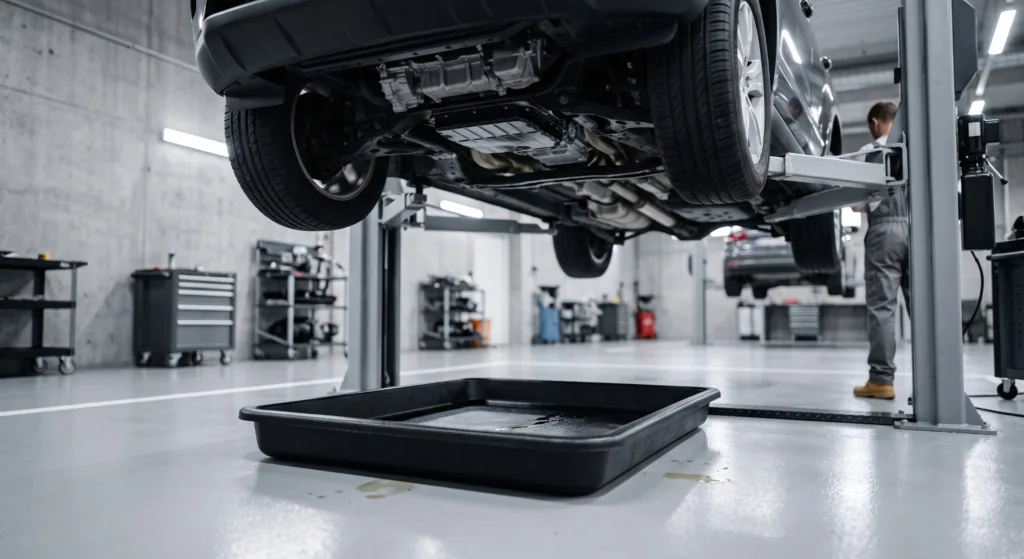
A slow leak rarely announces itself. A hydraulic fitting weeps a little oil overnight, a drum sits on a pallet for weeks with a faint drip, a piece of equipment sweats coolant during every shift, and nobody notices until there’s a stain on the floor that won’t come out.
Drip trays exist for exactly this kind of quiet, ongoing mess — but only if they’re placed where the leaks actually happen. This matters even more in UAE workshops and industrial facilities, where extreme heat accelerates seal degradation and speeds up how quickly a small leak becomes a bigger one. Here’s how to figure out exactly where trays belong.
Quick Answer: Drip trays belong under any continuously running equipment (presses, compressors, generators), under all stored drums and containers by default, and at every liquid transfer point. In the UAE specifically, outdoor trays also need to account for heat, UV exposure, and occasional heavy rain, which affect material choice and drainage design.
Where Drip Trays Belong in a UAE Workshop or Facility
Start With Anything That Runs Continuously
Any piece of equipment that operates for hours at a stretch is a candidate for a tray underneath it, whether or not it’s currently leaking. Hydraulic presses, compressors, generators, and machine tools all use oil or coolant that finds its way past seals over time, even on well-maintained equipment.
A tray here isn’t a reaction to a known problem — it’s an assumption that fluid will eventually escape and a plan for where it goes when it does. Waiting until a leak shows up before adding a tray usually means cleaning oil out of a concrete floor first, which is a far worse job than catching it early.
Drum and Container Storage Needs Trays by Default
Drums, IBC totes, and smaller containers are one of the most common sources of slow, easy-to-miss leaks. A bad seal, a hairline crack, or a bung that wasn’t tightened properly can drip for days before anyone notices, and by then the fluid has usually already reached the floor or a drain.
Storage areas — whether it’s a single drum near a workstation or a full staging area for incoming and outgoing containers, common across industrial zones like Al Quoz, Jebel Ali (JAFZA), and Dubai Industrial City — should have trays under every container as a standing rule, not something added after a leak is spotted.
Transfer Points Are Where Trays Earn Their Keep
Wherever liquid moves from one container to another — from a drum into a smaller container, from a tank into a machine, from a delivery truck into storage — there’s a higher chance of drips, splashes, and the last few ounces that miss the opening.
These are short, active moments rather than a slow drip, but they happen often enough that a spill tray at the transfer point saves repeated cleanup. Facilities that do frequent transfers, whether that’s fueling, lubricating, or decanting chemicals, tend to see the fastest payoff from trays placed directly at the point of pour rather than somewhere nearby “for convenience.”
Size the Tray to the Equipment, Not the Floor Space
A tray that’s picked because it fits neatly under a workbench usually isn’t picked for the right reason. The tray needs to match the footprint of what’s sitting on or over it, plus enough spare capacity to hold a realistic worst-case leak rather than just a few stray drops.
Undersized trays overflow quietly, which defeats the purpose entirely, since the fluid still ends up on the floor — just a little later than it would have without a tray at all.
Indoor vs Outdoor Placement Changes What You Need in the UAE
A tray sitting under an indoor lathe has very different requirements from one sitting under a generator outside, and this gap is wider in the UAE than in most climates. Outdoor placement here means intense heat, UV exposure, and occasional heavy rain during winter months all come into play, so material durability and drainage design matter more than they would in a milder climate.
Indoor placement can prioritize a low profile and easy access instead, since space and foot traffic are usually the bigger constraints in a typical Dubai or Sharjah workshop floor plan.
Many UAE facilities standardize on drip trays built to handle both settings, since having consistent, correctly specified trays across a site makes it easier for staff to know what belongs where without second-guessing it.
Drip Trays vs Spill Trays: Quick Comparison
| Use Case | Drip Tray | Spill Containment Tray |
|---|---|---|
| Continuous small leaks | Ideal — designed for ongoing, low-volume drips | Overkill for this use case |
| Drum/container storage | Works for single containers | Better for multi-drum staging areas |
| Active transfer points | Suitable for smaller volumes | Preferred for larger or hazardous transfers |
| Outdoor UAE placement | Needs UV-resistant, heat-tolerant material | Same requirement, larger capacity needed |
Trays Need a Maintenance Routine, Not Just a Purchase
Buying and placing a tray is only the first step. Trays fill up, and a tray that’s already full doesn’t do anything different from having no tray at all when the next leak happens. Regular checks, especially in areas with continuous equipment runtime or frequent transfers, keep a tray useful rather than turning it into a hidden hazard of its own.
Any tray that’s collected hazardous fluid also needs its contents handled and disposed of properly, in line with UAE environmental and municipal waste-handling regulations, not poured out or left to evaporate.
Frequently Asked Questions
Where should drip trays be placed in a workshop?
Under any continuously running equipment, under all stored drums and containers, and at every point where liquid is transferred between containers — these three categories cover the vast majority of leak sources in a typical facility.
What’s the difference between drip trays and spill trays?
Drip trays are generally built for smaller, ongoing leaks under equipment or single containers, while spill containment trays are designed for larger volumes, such as multi-drum staging areas or active bulk transfers.
Do drip trays need to be different for outdoor use in the UAE?
Yes. Outdoor trays in the UAE need UV-resistant, heat-tolerant materials and proper drainage design to handle both intense sun exposure and occasional heavy rain, unlike indoor trays which can prioritize a low profile instead.
How often should drip trays be checked and emptied?
This depends on equipment runtime and transfer frequency, but facilities with continuous operations or frequent liquid transfers should check trays regularly enough that they never reach full capacity before the next inspection.
How should hazardous fluid collected in a drip tray be disposed of?
It should be handled and disposed of according to standard spill-cleanup and hazardous waste rules, not poured out or left to evaporate — the same regulations that apply to spill cleanup generally apply to tray contents as well.
Conclusion
Drip trays only do their job when they’re placed where fluid actually escapes, not just where there happens to be room. Matching trays to continuously running equipment, container storage, and transfer points — then sizing and maintaining them properly for UAE conditions — is what separates a facility with genuinely dry floors from one that’s just cleaning up the same spot over and over.