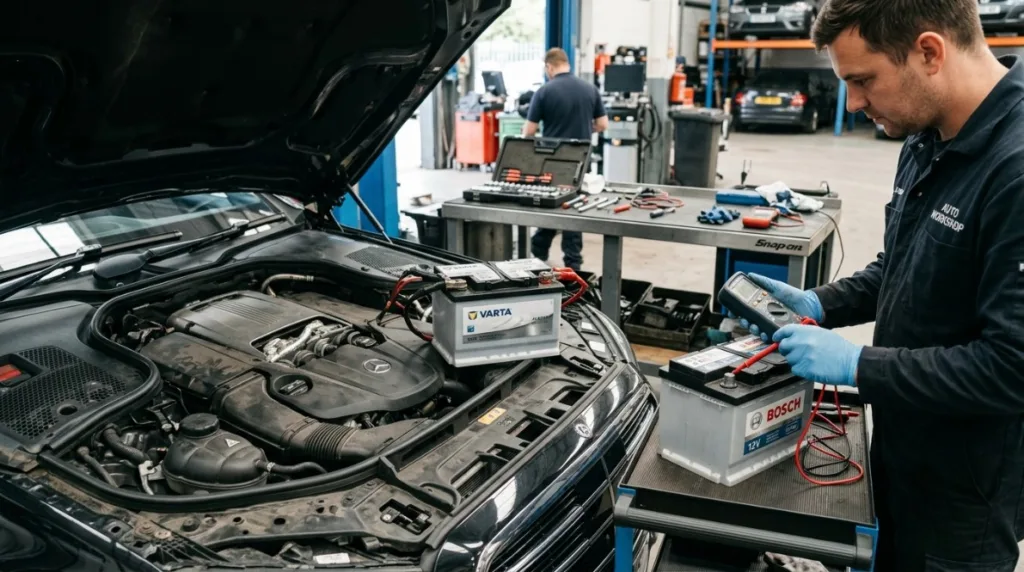
There’s a common assumption that any battery of roughly the right size will do the job. Pop out the old one, drop in a new one, and the car should run just fine. For a lot of older vehicles, that’s still true.
For modern ones, it’s often where problems quietly begin — not because the new battery is faulty, but because “new” and “right” have stopped meaning the same thing. This matters even more with a car battery in Dubai’s climate, where extreme heat already shortens battery lifespan regardless of brand or price point.
Quick Answer: A modern car battery in Dubai needs to match the vehicle’s exact chemistry (AGM, EFB, or standard flooded), sit within the correct capacity range, and be properly registered or coded with the car’s electronics after installation. Skipping registration is the most common mistake — the car will start and run normally on day one, but the charging system quietly mismanages the new battery for weeks before symptoms show up.
Why Choosing the Right Car Battery in Dubai Matters More Than Ever
Fitting the Tray Is Only the First Requirement
Physical size and terminal layout are the easiest part to get right, and also the part most people focus on entirely. A battery that fits the tray and connects to the existing cables looks like a correct replacement from the outside.
But modern vehicles factor in far more than physical dimensions when it comes to what actually counts as the right battery. A quick search for car battery near me will surface plenty of options, but proximity alone doesn’t tell you whether a shop handles registration and coding, or just swaps the unit and sends you off.
Chemistry Has to Match, Not Just Capacity
Many modern cars are built around a specific battery chemistry — standard flooded, EFB, or AGM — and that choice isn’t interchangeable.
Installing an AGM battery in a car engineered for EFB, or the reverse, doesn’t just reduce performance — it can shorten the battery’s working life dramatically, sometimes from years down to months. The wrong chemistry paired with the wrong charging profile confuses the vehicle’s charging system from the very first cycle.
Capacity matters too, though with more tolerance. A battery that’s noticeably under or over the specified amp-hour rating can throw off how the charging system manages it, even if it technically fits and starts the car on day one.
| Battery Type | Typically Used In | Key Trait |
|---|---|---|
| Standard Flooded | Older or basic vehicles without start-stop | Lowest cost, least tolerant of deep cycling |
| EFB battery | Entry-level start-stop systems | Improved cycling durability over flooded, moderate cost |
| AGM battery | Advanced start-stop, higher electrical load vehicles | Best cycling life and charge acceptance, higher cost |
Many Modern Cars Need the Battery “Introduced” to the System
This is the part that catches most people off guard. A growing number of vehicles, particularly those with start-stop technology, use a battery management system that tracks the age, condition, and charging behavior of the battery currently installed. This is especially common in vehicles designed around an EFB battery for start-stop functionality, where the system expects specific charging behavior from day one.
When a new battery goes in, that system often needs to be told — through a process called battery registration or coding — that a fresh unit has replaced the old one.
Skip this step, and the car’s electronics may continue charging based on the old battery’s profile, essentially treating a brand-new battery as if it were already years old.
What Actually Happens When This Gets Missed
The consequences rarely show up as a dramatic failure right away, which is part of why this step gets overlooked so often. Instead, a mismatched or unregistered battery tends to develop problems gradually: undercharging that leads to sulfation, a start-stop system that quietly disables itself, slightly reduced fuel efficiency as the engine keeps running when it should be shutting off, or dashboard warning lights that seem to appear for no clear reason.
By the time these symptoms become noticeable, the battery has often already been operating under the wrong conditions for weeks, sometimes shortening its total lifespan by years compared to a properly matched and registered installation.
Why the Problem Feels Invisible at First
A car will typically start and drive normally on the day a mismatched battery is installed, which reinforces the assumption that everything went fine.
The real damage tends to build quietly over the following weeks as the charging system continues operating on outdated or incorrect information, making this one of those issues that’s far easier to prevent than to diagnose after the fact.
Getting the Right Car Battery in Dubai: The Full Job, Not Just the Swap
Every car battery replacement in Dubai handled by Battery Zone UAE includes this step as standard, confirming the correct chemistry and capacity for the vehicle and completing any registration or coding the manufacturer requires, rather than treating the job as finished once the new unit is bolted in.
Frequently Asked Questions
What’s the difference between AGM and EFB batteries?
An AGM battery offers better cycling life and charge acceptance, making it suited to vehicles with heavier electrical loads or advanced start-stop systems. An EFB battery is a step up from standard flooded batteries and fits entry-level start-stop systems, but generally costs less than AGM.
Does a car battery in Dubai need anything different because of the heat?
Extreme heat accelerates chemical degradation in all battery types, so correct chemistry matching and proper installation matter even more here than in cooler climates — a mismatched battery will fail faster under UAE conditions than it might elsewhere.
What is battery registration or coding?
It’s a process that tells the vehicle’s battery management system a new battery has replaced the old one, so the charging system manages it correctly from day one instead of continuing to apply the old battery’s charging profile.
Will a car still run if the battery isn’t registered?
Yes, initially. The car typically starts and drives normally on day one, which is exactly why the problem often goes unnoticed until symptoms like reduced fuel efficiency or unexplained warning lights appear weeks later.
How do I find a shop that handles registration, not just replacement?
Ask directly before booking. A search for car battery near me will list plenty of options, but not all of them include chemistry matching and registration as part of the standard service — confirm this upfront rather than assuming it’s included.
Conclusion
A new battery and the right battery aren’t automatically the same thing in a modern car. Matching chemistry and capacity gets the fitment right, but registering that battery with the vehicle’s electronics is often what actually determines whether it performs the way it’s supposed to for the next several years, not just on the day it’s installed.