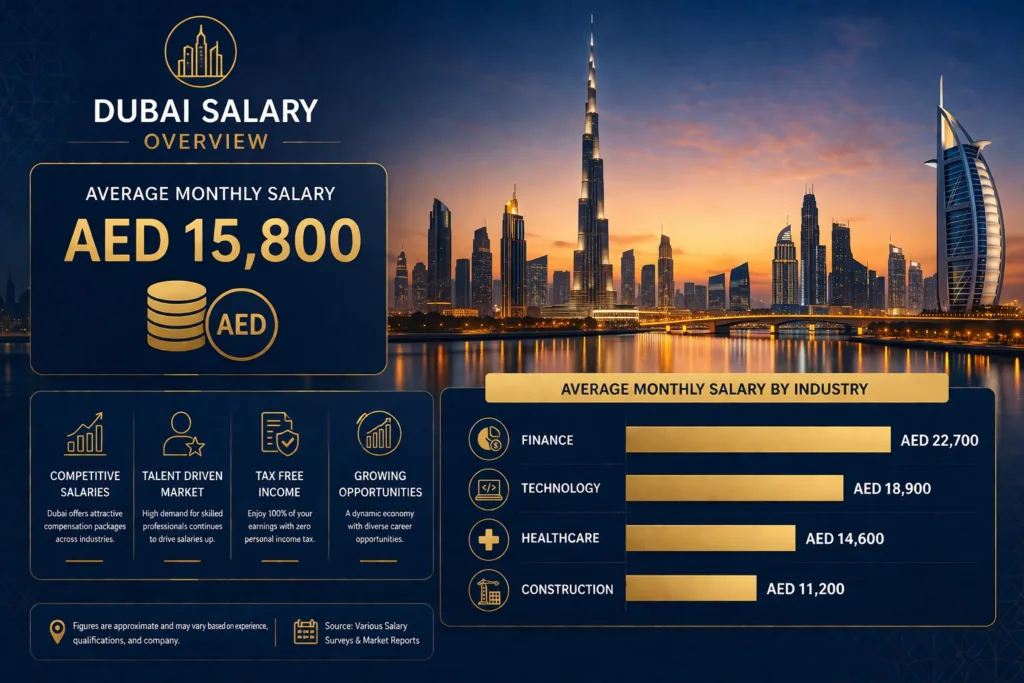
If you are weighing up a job offer in Dubai or planning your move, the average salary in Dubai 2026 sits at approximately AED 15,800 per month (around USD 4,300) based on aggregated data from Michael Page, Hays, and GulfTalent salary surveys. The median — a more honest figure — is closer to AED 13,800 per month.
But the raw number tells only half the story. Dubai has zero personal income tax. That AED 15,800 is what lands in your bank account — no deductions, no PAYE, no national insurance.
Quick Summary Box — Average Salary in Dubai 2026
- Average monthly salary: AED 15,800 (~USD 4,300)
- Median monthly salary: AED 13,800 (~USD 3,760)
- Salary range: AED 4,810 to AED 99,000+ per month
- Income tax: Zero — your gross salary is your take-home pay
- Highest-paying sectors: Finance/banking, technology (AI/cybersecurity), healthcare
- Minimum salary for UAE family visa sponsorship: AED 4,000–4,500/month basic
- Golden Visa salary threshold: AED 30,000/month basic (skilled professionals)
- Emirati private sector minimum wage (2026): AED 6,000/month (effective January 2026)
The average salary in Dubai in 2026 looks strong on paper, but understanding what drives it is what helps you negotiate properly.
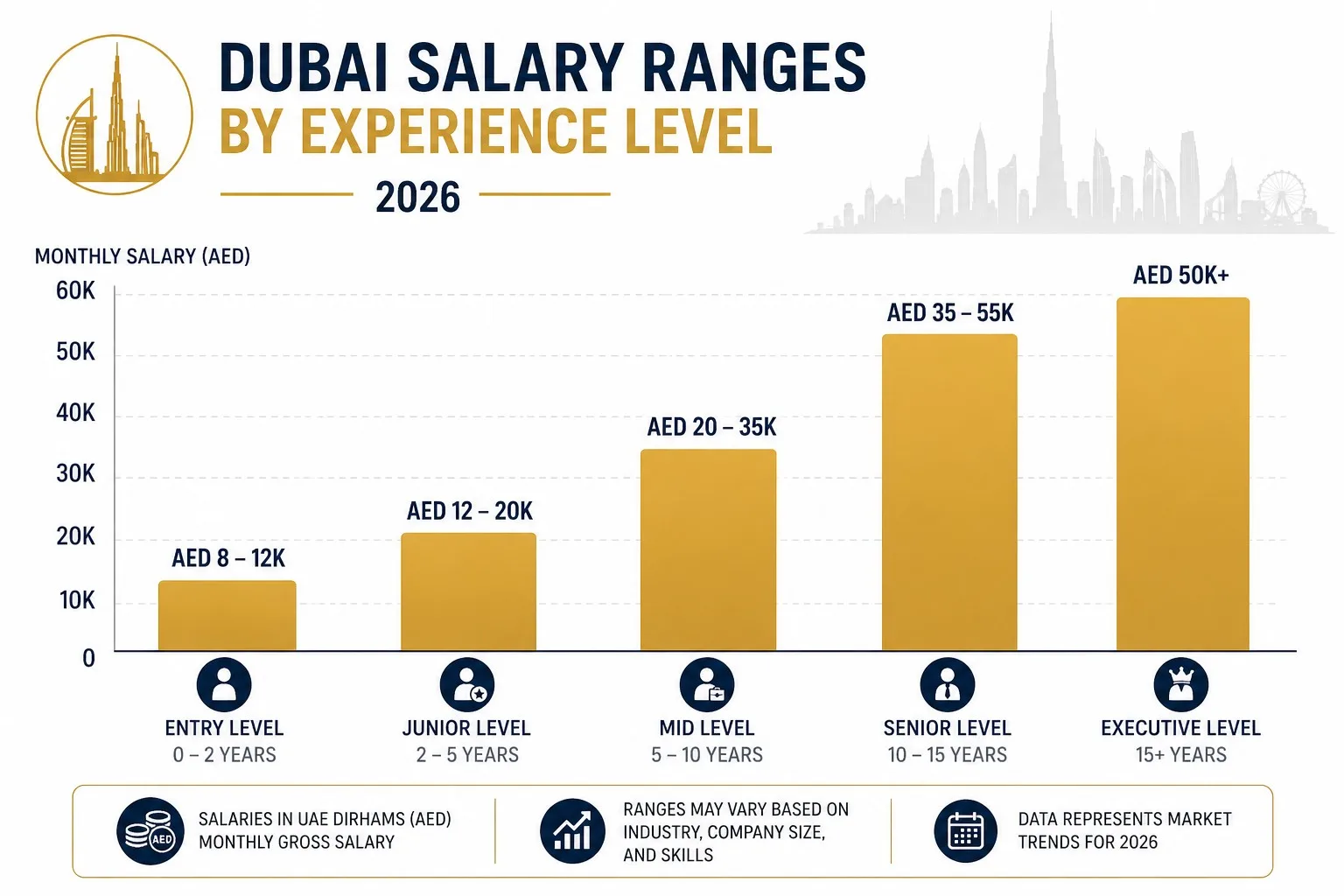
The AED 15,800 average is pulled upward by high earners in finance, tech, and oil. The median of AED 13,800 is the more realistic benchmark for professionals across all sectors. Entry-level roles typically start between AED 8,000–12,000, mid-level professionals earn AED 15,000–25,000, and senior managers or executives can command AED 30,000–50,000+.
One figure worth noting for 2026: the Ministry of Human Resources and Emiratisation (MoHRE) raised the private-sector minimum monthly wage for UAE nationals to AED 6,000, effective January 2026. This applies to Emiratis only — there is still no legally mandated minimum wage for expat workers.
Dubai Salary by Industry 2026 — Finance, Tech, Healthcare & More
Salaries vary enormously by sector. Here is a realistic breakdown based on current recruitment market data from Michael Page UAE and Hays Gulf 2026 reports:
| Industry | Entry Level (AED/month) | Mid-Level (AED/month) | Senior Level (AED/month) |
|---|---|---|---|
| Banking & Finance | 12,000–18,000 | 22,000–40,000 | 40,000–70,000+ |
| Technology (AI/Software/Cyber) | 10,000–18,000 | 20,000–35,000 | 35,000–60,000+ |
| Healthcare (Doctors/Specialists) | 15,000–25,000 | 28,000–50,000 | 50,000–90,000+ |
| Oil & Gas / Energy | 12,000–20,000 | 25,000–45,000 | 45,000–80,000+ |
| Engineering & Construction | 8,000–14,000 | 15,000–28,000 | 28,000–50,000+ |
| Legal & Consulting | 10,000–18,000 | 22,000–38,000 | 38,000–65,000+ |
| Marketing & PR | 7,000–12,000 | 14,000–25,000 | 25,000–40,000+ |
| Hospitality & Retail | 4,000–8,000 | 8,000–15,000 | 15,000–25,000+ |
| Education | 6,000–10,000 | 10,000–18,000 | 18,000–30,000+ |
| Logistics & Supply Chain | 6,000–12,000 | 14,000–22,000 | 22,000–38,000+ |
Worked Example: A mid-level software engineer with 5 years of experience joins a tech firm in Dubai at AED 22,000/month gross. In the UK, an equivalent role might pay £55,000 (~AED 26,500). But after 40% UK tax, the UK engineer takes home ~AED 15,900. The Dubai engineer takes home the full AED 22,000 — roughly AED 6,100 more every single month.
Technology roles are seeing the sharpest salary growth. AI, cybersecurity, cloud computing, and blockchain specialists are commanding premiums of 15–25% above the market average for comparable experience levels. Healthcare is also growing fast, driven by Dubai’s Health Strategy 2026 expansion.
💡 Internal link opportunity: If you are relocating and want to understand your end-of-service pay, read our UAE Gratuity Calculator guide — it explains how your basic salary (not gross) determines your gratuity payout.
Average Salary by Experience Level in Dubai
Experience is the single biggest lever on your salary in Dubai. Here is how earnings typically scale:
| Experience Level | Monthly Salary Range (AED) | Annual Salary Range (AED) |
|---|---|---|
| Entry Level (0–2 years) | 8,000–12,000 | 96,000–144,000 |
| Junior Professional (2–5 years) | 12,000–20,000 | 144,000–240,000 |
| Mid-Level (5–10 years) | 20,000–35,000 | 240,000–420,000 |
| Senior Level (10–15 years) | 35,000–55,000 | 420,000–660,000 |
| Executive/Director (15+ years) | 50,000–100,000+ | 600,000–1,200,000+ |
Worked Example: An accountant with 4 years of experience earning AED 16,000/month switches firms after gaining a relevant certification. Their new salary: AED 21,000. That AED 5,000 increment translates to AED 60,000 extra per year — tax-free. In a country with income tax, that jump would require a much larger nominal raise to achieve the same outcome.
Salary increments in Dubai run competitive: 2.5–5% annually across most sectors, with healthcare offering up to 8% and IT up to 6% in high-demand specialisations.
Basic Salary vs Gross Salary in UAE — The Distinction That Costs Expats Money
This is the section most salary guides skip, and it is the one that matters most.
What is basic salary in the UAE?
Your basic salary is the fixed amount written in your employment contract — before any allowances. It excludes housing allowance, transport allowance, performance bonuses, commissions, and any other add-ons. A typical Dubai salary structure looks like this:
| Salary Component | Percentage of Package |
|---|---|
| Basic Salary | 50–60% |
| Housing Allowance | 20–25% |
| Transport Allowance | 5–10% |
| Other Allowances/Benefits | 10–15% |
Why does this matter? Because the UAE Labour Law (Federal Decree-Law No. 33 of 2021) calculates your end-of-service gratuity, overtime pay, and leave encashment on basic salary only — not gross.
Worked AED example — how a high gross hides a low basic
An employer offers you AED 20,000/month gross. Attractive, right? But the package breaks down as:
- Basic salary: AED 9,000
- Housing allowance: AED 7,000
- Transport allowance: AED 2,000
- Other: AED 2,000
After 5 years, your gratuity is calculated on AED 9,000 basic — not AED 20,000. That means your gratuity payout after 5 years is approximately AED 31,500 (9,000 ÷ 30 × 21 × 5). If basic were AED 14,000 instead, it would be AED 49,000.
Always ask for the basic salary figure specifically when evaluating job offers. A big gross number can mask a surprisingly low statutory entitlement.
🔴 Real Talk: Companies in Dubai legally structure high allowances and low basic salaries specifically to reduce their gratuity liability. This is entirely legal. You will never see a recruiter mention it. Ask every employer: “What is the basic salary figure, and how is gratuity calculated?” Get it in writing before you sign.
The Wage Protection System (WPS), administered by MoHRE, ensures your salary is paid electronically through approved banks and financial channels. If your employer delays salary payment, WPS flags the violation and penalties apply. Your payslip through WPS will show the basic salary breakdown — always check it matches your contract.
Minimum Salary Requirements for Visa Sponsorship in Dubai 2026
Your salary in Dubai is not just about lifestyle — it directly determines what visas you can access and who you can sponsor.
Family visa sponsorship salary thresholds
To sponsor your family in Dubai on a standard employment visa, the General Directorate of Residency and Foreigners Affairs (GDRFA) requires the following minimum monthly basic salary:
| Family Member | Minimum Salary Required (AED/month) |
|---|---|
| Spouse + Children | AED 4,000 (with employer accommodation) |
| Spouse + Children | AED 4,500 (without employer accommodation) |
| Parents | No fixed minimum — assessed individually (typically AED 15,000+) |
Golden Visa average salary in Dubai 2026 requirement
The UAE Golden Visa for skilled professionals requires a basic monthly salary of at least AED 30,000, along with a bachelor’s degree and a MoHRE Skill Level 1 or 2 classification. From 2026, this threshold applies to the basic salary, not gross — a meaningful tightening that catches many applicants off guard.
Golden Visa holders have no minimum salary requirement to sponsor family members. If you are near the threshold, it is one of the most practical long-term residency upgrades available in Dubai.
💡 Internal link: Planning to bring your family over? Read our guide on UAE visa requirements for expats to understand the sponsorship documentation process.
What is a ‘Good’ Salary in Dubai? A Real Cost of Living Benchmark
“Good salary” is relative — but here is a practical breakdown of what different income levels actually mean in Dubai:
| Monthly Salary (AED) | Lifestyle Reality |
|---|---|
| Below 7,000 | Tight budget, shared housing essential, limited savings |
| 7,000–12,000 | Basic comfortable, shared or studio apartment, possible |
| 12,000–20,000 | Comfortable single life, 1-bed in mid-range area, savings possible |
| 20,000–35,000 | Good lifestyle, family support possible, savings and leisure |
| 35,000–60,000 | Very comfortable, international school, quality accommodation |
| 60,000+ | Premium lifestyle, villa, international schooling, strong savings |
Key monthly expenses to benchmark against your salary:
- 1-bed apartment (mid-range area): AED 6,000–9,000/month
- Family apartment (2-3 bed): AED 10,000–18,000/month
- International school fees: AED 2,500–6,500/month per child
- Groceries (single person): AED 800–1,200/month
- Health insurance (mid-range): AED 250–580/month
- Transport (public or car running costs): AED 800–2,000/month
Worked Example: A marketing manager earning AED 22,000/month gross (AED 13,000 basic): After rent of AED 8,000 for a 1-bed, groceries at AED 1,000, transport AED 1,200, insurance AED 400, and utilities AED 500 — they are left with roughly AED 10,900 for savings, leisure, remittances, or investing. No income tax deducted. That same manager in Germany on a €4,500/month salary (~AED 18,000) would take home around AED 11,200 after ~38% tax — with a significantly higher cost of living.
How UAE Zero Tax Changes Your Real Earnings in 2026
This is the content gap no competitor article addresses properly, so pay attention.
The UAE has no personal income tax. What you earn, you keep — entirely. This creates a purchasing power advantage that compound-effects over years.
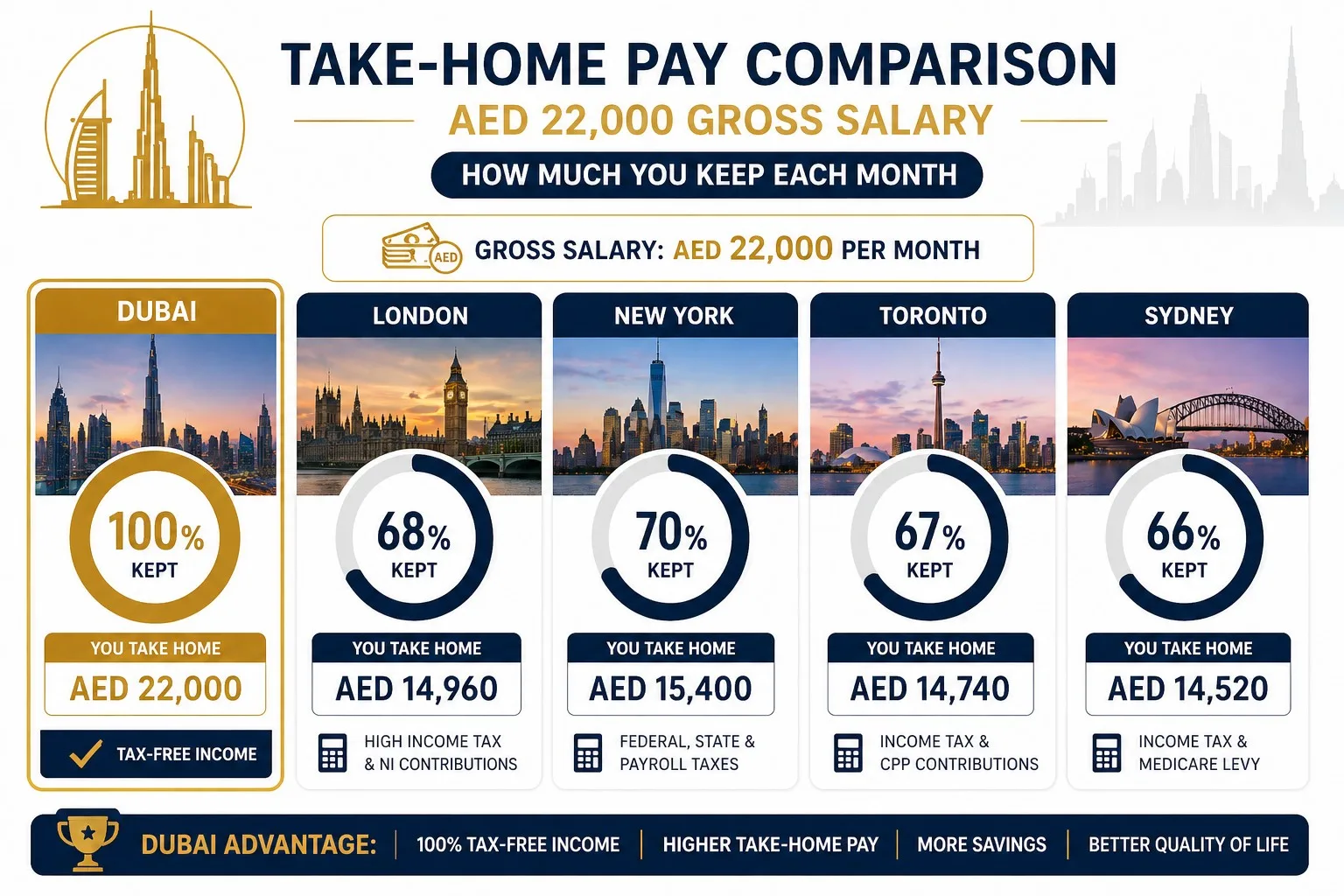
Here is how a mid-level professional salary of AED 22,000/month (USD 5,990) compares across major cities on a net take-home basis:
| City | Gross Monthly | Tax Rate (approx.) | Monthly Take-Home (AED equiv.) |
|---|---|---|---|
| Dubai | AED 22,000 | 0% | AED 22,000 |
| London | AED 22,000 equiv. | ~32% | AED 14,960 |
| New York | AED 22,000 equiv. | ~30% | AED 15,400 |
| Toronto | AED 22,000 equiv. | ~33% | AED 14,740 |
| Sydney | AED 22,000 equiv. | ~34% | AED 14,520 |
| Singapore | AED 22,000 equiv. | ~11% | AED 19,580 |
Worked Example: You are a financial analyst earning AED 22,000/month in Dubai. Over 5 years, that is AED 1,320,000 in take-home pay. The same gross salary in London would yield approximately AED 897,600 after tax. Dubai puts an extra AED 422,400 in your pocket over five years — before you even factor in savings returns or investment.
The caveat: Dubai’s cost of living is real, particularly housing and schooling. The tax advantage is largest for professionals earning above AED 20,000 who keep housing and schooling costs under control.
Salary Negotiation Tips for Expats in Dubai 2026
Negotiating in Dubai is different from most Western markets, and knowing the rules gives you a real edge.
Know your basic salary number first. Always establish what the basic salary component is — not just the gross package. This determines your gratuity, overtime, and leave pay for the duration of your employment.
Benchmark before you walk in. Use the Michael Page UAE Salary Guide, Hays Gulf Salary Guide, and GulfTalent to establish your market rate by job title, industry, and years of experience before any negotiation.
Negotiate allowances separately. Housing and transport allowances are often negotiable independently of basic salary. Pushing for a higher housing allowance can be easier than increasing basic, and it still improves your take-home pay (though not your gratuity).
Factor in benefits that have AED value. Annual flights home, private medical insurance for family, school fee contributions, and car allowances are standard in senior packages. A package offering AED 30,000 gross with school fees paid can be worth significantly more than AED 35,000 gross without.
Counter with total compensation math. If an employer is resistant to salary increase, present the tax-equivalent calculation. “This AED 28,000 is equivalent to earning £70,000 in the UK after tax” — it reframes the discussion with data.
The right time to negotiate is at the offer stage. Once you accept and onboard, salary reviews in Dubai typically happen annually at 2.5–5%. Front-load your negotiation.
💡 Internal link: Thinking of starting your own business instead of employment? Read our guide on how to start a business in the UAE and understand the income and visa implications.
FAQ — Average Salary in Dubai 2026
Q1: What is the average salary in Dubai per month in 2026? The average monthly salary in Dubai in 2026 is approximately AED 15,800, based on salary surveys from recruitment firms including Michael Page and Hays. The median is AED 13,800 — a more representative figure for most working professionals.
Q2: What is considered a good salary in Dubai in 2026? For a single professional, AED 15,000–18,000/month covers comfortable living with savings. For a family with one child in an international school, AED 30,000–35,000/month is a practical minimum for a quality lifestyle without financial stress.
Q3: Is there a minimum wage in Dubai? There is no legally mandated minimum wage for expat workers in Dubai. From January 2026, UAE nationals working in the private sector have a minimum monthly wage of AED 6,000 under MoHRE rules. Non-binding guidelines from 2013 suggest AED 12,000 for graduates and AED 7,000 for skilled technicians, but these are not enforceable.
Q4: What is the difference between basic salary and gross salary in UAE? Basic salary is the fixed amount in your contract. Gross salary includes basic plus all allowances (housing, transport, etc.). Under UAE Labour Law (Federal Decree-Law No. 33 of 2021), gratuity, overtime, and leave encashment are calculated on basic salary only — not gross. This distinction directly affects your end-of-service payout.
Q5: What salary do I need to sponsor my family in Dubai? To sponsor your spouse and children on a standard employment visa, GDRFA requires a minimum monthly basic salary of AED 4,000 (with employer accommodation) or AED 4,500 (without). For the UAE Golden Visa, the threshold is AED 30,000 basic salary for skilled professionals.
Q6: What salary qualifies for the UAE Golden Visa in 2026? Skilled professionals need a basic monthly salary of at least AED 30,000, a bachelor’s degree, and a MoHRE Skill Level 1 or 2 classification. From 2026, this is assessed on basic salary, not gross package.
Q7: How does zero income tax in Dubai affect my real earnings? Because there is no personal income tax in the UAE, your gross salary equals your net salary. A professional earning AED 22,000 in Dubai keeps AED 22,000. The same gross in London would yield approximately AED 14,960 after tax — a difference of AED 7,040/month or AED 84,480/year.
Q8: What are the highest-paying industries in Dubai in 2026? Finance and banking, technology (AI, cybersecurity, cloud), oil and gas, healthcare (specialist doctors), and legal consulting consistently offer the highest salaries. Investment bankers can earn AED 35,000–60,000/month, AI specialists AED 25,000–40,000, and medical specialists AED 50,000–90,000.
Q9: Does Dubai pay salaries monthly? Yes. All UAE employers are required to pay salaries monthly through the Wage Protection System (WPS), administered by the Ministry of Human Resources and Emiratisation (MoHRE). Employers who fail to pay on time face work permit bans and penalties.
Q10: How do Dubai salaries compare to the rest of the GCC? The UAE has the highest average gross monthly wage in the GCC at approximately USD 3,663 (AED 13,400). Qatar follows at around USD 3,168, with Bahrain at USD 1,728 and Oman at USD 1,626. However, UAE cost of living — particularly in Dubai — is the highest in the GCC.