Landing a job offer in Dubai is exciting, but the paperwork that follows can feel confusing. Who applies, what documents you need, how much it costs and how long it takes all depend on rules set by MOHRE, GDRFA and ICP. This 2026 guide explains the Dubai work visa requirements in plain language, with official fees, a step-by-step timeline and the mistakes that delay most applications.
Quick Answer: The main Dubai work visa requirements are a job offer from a licensed UAE employer, a passport valid for 6+ months, a white-background photo, attested certificates for skilled roles, and a medical fitness test after arrival. Your employer applies and pays the fees. Most visas are issued in 2–4 weeks.
Dubai Work Visa Requirements 2026: Full Checklist
A Dubai work visa is really three approvals issued one after another: a MOHRE work permit, an entry permit that lets you fly in, and a 2-year residence visa linked to your Emirates ID. Your employer (or free zone authority) handles all three. You cannot apply for a Dubai employment visa on your own; you need a sponsor.
Who Is Eligible for a Dubai Employment Visa?
You qualify if all of these are true:
- You are 18 or older.
- You have a signed job offer from a company with a valid trade licence and an available visa quota.
- The job matches the company’s licensed activity.
- You do not already hold an active UAE work permit with another employer.
- You can pass the medical fitness test in the UAE.
There is no nationality cap, no lottery and no language test. Some nationalities (for example Pakistan, Afghanistan, Iraq and Iran) must also submit a copy of their national ID card, according to MOHRE.
Documents Required for a Dubai Work Visa
Paperwork is the core of the Dubai work visa requirements. Use this table as your document checklist. Prepare scans before your employer asks, because missing papers are the number one cause of delays.
| Document | Who provides it | Notes |
|---|---|---|
| Passport copy | You | At least 6 months’ validity |
| Passport photo | You | Recent, colour, white background |
| Signed job offer | You + employer | Official MOHRE offer form |
| Educational certificates | You | Attested for skilled roles (degree or diploma) |
| Professional licence | You | Doctors, nurses, teachers, lawyers, engineers |
| National ID copy | You | Only for certain nationalities |
| Trade licence and quota | Employer | Must be valid with no violations |
| Medical fitness certificate | UAE medical centre | Done after you arrive |
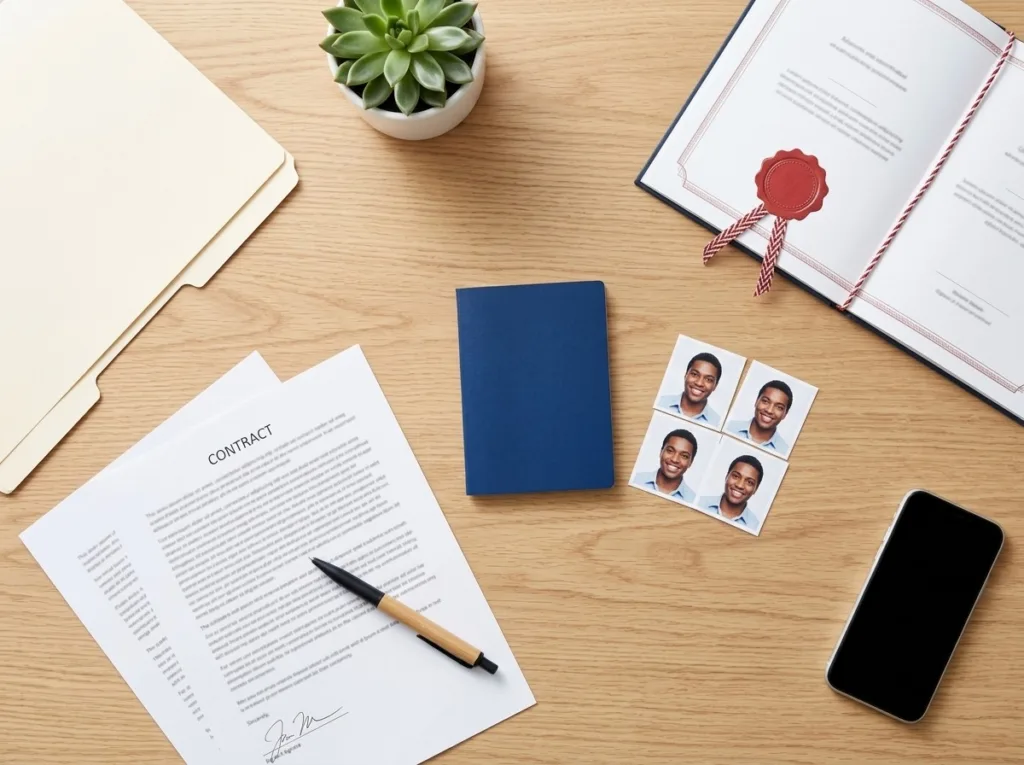
Getting Your Degree Attested
For skilled jobs, MOHRE asks for certificates that match your skill level. Attestation usually runs in three stages: your home country’s education authority or notary, its foreign ministry, then the UAE embassy. Once in the UAE, the certificate is stamped by the UAE Ministry of Foreign Affairs. Start early, because this can add 2–4 weeks.
How to Get Work Visa in Dubai: Step-by-Step
Here is how to get work visa in Dubai once you accept an offer. Mainland companies use MOHRE and GDRFA; free zone companies use their free zone authority, but the steps are similar.
- Sign the job offer. Check salary, job title and allowances before signing; these copy into your labour contract.
- Employer applies for the work permit. MOHRE lists a service time of about 2 working days once documents are complete.
- Entry permit is issued. This “pink visa” is usually valid for 60 days. Fly to the UAE before it expires.
- Medical fitness test. Visit a government-approved medical centre for a blood test and chest X-ray.
- Emirates ID biometrics. Give fingerprints and a photo at an ICP or approved typing centre.
- Sign the labour contract. The MOHRE contract must match the offer you signed.
- Residence visa is issued. GDRFA issues the 2-year residence; it is now digital and linked to your Emirates ID.
- Register for ILOE insurance and set up your salary account (a bank or a WPS card).

Inside the UAE on a visit visa? Your employer can change your status without you exiting, for an extra in-country fee.
Dubai Work Visa Cost in 2026
Under UAE Labour Law (Federal Decree-Law No. 33 of 2021, Article 6), the employer must pay recruitment and visa costs. An employer cannot charge you for them or deduct them from your salary. The total Dubai work visa cost for the employer depends mainly on the company’s MOHRE category.
| Fee item | Amount (AED) | Source |
|---|---|---|
| Work permit application | 50 | MOHRE |
| Work permit (2 years), Category 1 company | 250 | MOHRE |
| Work permit (2 years), Category 2 company | 1,200 | MOHRE |
| Work permit (2 years), Category 3 company | 3,450 | MOHRE |
| Residence permit + Knowledge and Innovation fees | 220 | GDRFA |
| In-country status change (if already in UAE) | 500 | GDRFA |
| Medical fitness test | about 300–750 | Normal vs VIP |
| Emirates ID (2 years) | about 270–370 | ICP, incl. service fees |
| Health insurance | from about 600/year | Employer-paid |
Typing centre charges, entry permit fees and insurance push the typical total to roughly AED 3,000–7,500 per employee in 2026. Check the latest figures on the MOHRE new work permit service page and the GDRFA private sector residence page.
What You Pay Yourself
- Degree attestation in your home country (unless your employer reimburses it).
- Your flight, if the contract does not cover it.
- ILOE job loss insurance: about AED 5 a month if your basic salary is AED 16,000 or less, or AED 10 a month above that. Subscribe on the official ILOE portal; missing it can lead to a AED 400 fine.
Dubai Work Visa Processing Time
The Dubai work visa processing time is usually 2–4 weeks from offer to residence visa. Each stage has its own clock:
| Stage | Typical time |
|---|---|
| Work permit approval | 2–5 working days |
| Entry permit | 2–5 working days |
| Medical test results | 24–48 hours (VIP same day) |
| Emirates ID biometrics to card | 5–10 working days |
| Residence visa (GDRFA) | About 48 hours once complete |
Free zone visas are often a little faster than mainland visas. Unattested certificates, name spelling mismatches and an exhausted company quota are the usual reasons the timeline stretches to 6 weeks or more.
Mainland vs Free Zone Work Visas
Both meet the same core Dubai work visa requirements, but they differ in who runs the process.
| Feature | Mainland | Free zone |
|---|---|---|
| Permit issued by | MOHRE | Free zone authority |
| Residence issued by | GDRFA | GDRFA via the free zone |
| Can work outside the zone? | Yes, anywhere in the UAE | Only for that free zone employer |
| Labour disputes | MOHRE | Free zone authority (or DIFC/ADGM courts) |
If you prefer to work for several clients instead of one employer, a freelance permit is a separate route; see our guide to the freelance visa in Dubai.
Medical Test Rules
The medical test is one of the Dubai work visa requirements you can only complete inside the UAE. All new residents aged 18 and over need a medical fitness certificate. The test screens for tuberculosis (chest X-ray) and certain infectious diseases (blood test). Some job categories, such as domestic workers, food handlers, nurseries and salons, need extra screening. Results normally arrive by SMS within 48 hours and are shared directly with the visa system.
Common Reasons a Dubai Work Visa Gets Rejected
Most rejections happen because one of the Dubai work visa requirements was not met:
- The company has no free quota or has unpaid fines.
- The job title does not match your qualifications or the company’s licence.
- You already have an active work permit or a labour ban from a previous job.
- Unfit medical result, such as active TB.
- Security clearance issues or mismatched personal details.
Before you sign, check your status with our guide on how to check UAE visa status online. If an old visa still shows as active, ask your former employer to cancel it first.
After You Get the Visa: Rights and Rules to Know
Meeting the Dubai work visa requirements is only the start. Keep these rules in mind for the next two years:
- Grace period: if your visa is cancelled or expires, GDRFA gives you 60 days to leave, find a new sponsor or change status. After that, overstay fines of AED 50 a day apply.
- Changing jobs: you no longer need an NOC in most cases, but your new employer must issue a new work permit.
- Family sponsorship: you can sponsor a spouse and children with a salary of about AED 4,000, or AED 3,000 plus accommodation.
- Losing your job: read our step-by-step guide on what to do after a lost job in UAE visa situation to protect your residency.
Country-specific rules also apply. See our guides for Indian citizens, Pakistani nationals and Filipino citizens.
Frequently Asked Questions
Can I apply for a Dubai work visa myself?
No. A standard Dubai employment visa must be requested by a licensed employer or free zone. You can only self-sponsor through other routes such as a freelance, Green or Golden visa.
Who pays for a work visa in Dubai?
The employer. UAE Labour Law bans employers from charging workers for visa or recruitment costs, directly or through salary deductions.
How long is a Dubai work visa valid?
A standard work residence visa is valid for 2 years and can be renewed for another 2 years while you stay employed.
Is a degree one of the Dubai work visa requirements?
Not for every job. MOHRE asks for certificates matching the skill level of the role. Professional jobs need an attested degree; many skilled and semi-skilled jobs accept a high school or diploma certificate.
Can I work in Dubai on a visit visa?
No. Working on a visit visa is illegal and can lead to fines and a ban. You may visit to job hunt, but your employer must issue a work permit before you start.
What happens to my visa if I resign?
Your employer cancels your work permit and residence visa. You then have a 60-day grace period to join a new employer or leave the UAE.
Final Word
The Dubai work visa requirements in 2026 are simple once you see the order: offer, work permit, entry permit, medical, Emirates ID, residence. Keep your passport valid, get your certificates attested early, and never pay visa fees your employer should cover. For more practical help settling in, see our UAE government services guide and our guide to the Ratibi salary card.